"Let it be known that homosexuals are not cowards."
— From the legacy of Willem Arondeus, 1943
How can queer resilience be upheld and strengthened in times of discrimination, political shift to the right, and growing uncertainty?
Taking as its starting point the life and work of Dutch artist and resistance fighter Willem Arondeus (1894–1943), this artistic-research project explores what queer resistance meant then and what it can mean today. Arondeus, openly homosexual and a courageous member of the Dutch resistance against the Nazi regime, serves as a historical figure of reference for a contemporary reflection on queer identity, threat, and solidarity.
The project combines biographical investigation with artistic research and socio-political analysis. In an era of increasing uncertainty and anti-queer rhetoric, it seeks to highlight the strategies queer people develop today to strengthen resilience, and how empowerment, visibility, and resistance can be rooted within collective experience.
The exhibited works aim to expand queer memory culture, create spaces for dialogue, and open new perspectives.
If you are interested in the link for the film, please send me a message.
The first exhibition is a production of the Habibi Kosk of the Münchner Kammerspiele and took place from 29/11 to 12/12/2025. The Habibi Kiosk is an open exhibition and project space and is located in the Maximilianstraße in Munich. As a low-threshold venue at the intersection of art, theatre, and urban society, it deliberately addresses a diverse audience and provides contemporary artistic positions with high visibility beyond traditional exhibition contexts.


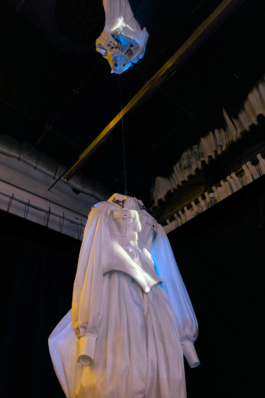
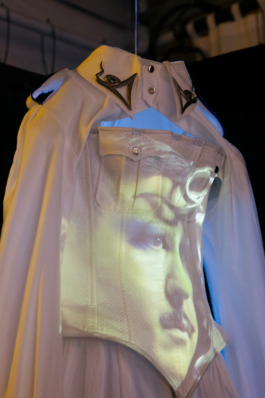
Installation view of Drag Resistance, 2025 (Photo: Sandra Singh)
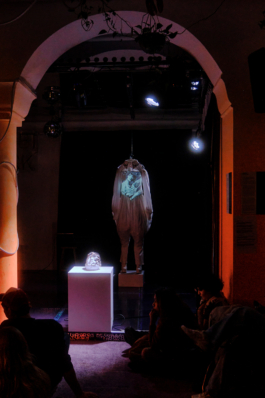
Installation view of Drag Resistance, 2025
The opening took place on 29/11. The evening began with an introduction to the project by curators Sophie Eisenried and Gina Penzkofer. This was followed by a performance by British spoken-word artist Otis Mensah together with the musician Cavid Dhen, whose contribution thematically engaged with queer resilience, memory, and resistance. (Photos: Sandra Singh)
I. Drag Resistance
The sub-project Drag Resistance is a short film and performance-based work conceived as a homage to the Dutch artist and resistance fighter Willem Arondeus (1894–1943). Arondeus was an illustrator, writer, and openly homosexual activist who joined the Dutch resistance during World War II. Together with fellow artists, he forged identity documents and helped lead the 1943 attack on the Amsterdam Public Records Office, an act that destroyed thousands of records and saved countless lives.
The film reinterprets Arondeus’ legacy through drag as an aesthetic and political language. Combining archival references, spoken word, and performative imagery, drag becomes a medium of transformation, disguise, and empowerment, echoing Arondeus’ use of camouflage, false identities, and artistic practice as tools of resistance.
At the center of the film is my drag persona, Aron Divine, whose performance bridges past and present. Through costume, movement, and projection, the film embodies queer resilience and asks how historical acts of resistance can be translated into contemporary forms of visibility and self-assertion. Rather than reconstructing history, the film activates it, using performance to carry memory forward and to affirm drag as a living, defiant practice of remembrance.
The film is part of a video installation and is projected directly onto the costume worn in the performance. In the exhibition context, the costume functions as an autonomous sculptural body and projection surface, allowing the moving image to inhabit the garment itself.



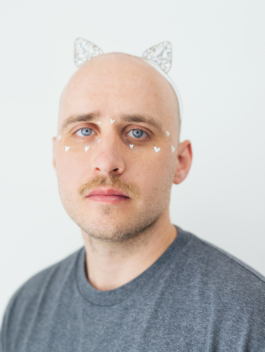


Bonyad Bastanfar and Neda Paiabandi for Links for Rechts, 2025
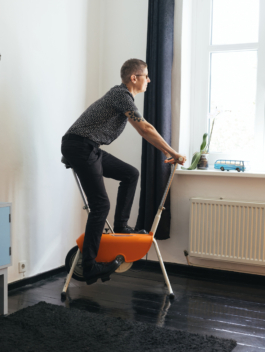
Bonyad Bastanfar for Links for Rechts, 2025
Neda Paiabandi for Links for Rechts, 2025
Toni Karat for Links for Rechts, 2025
Caspar Weimann for Links for Rechts, 2025
Jules Romeo for Links for Rechts, 2025
Mel for Links for Rechts, 2025
Roxy Rued for Links for Rechts, 2025
Melissa Kolukisagil for Links for Rechts, 2025
Saeleen Bouvar for Links for Rechts, 2025
X
X


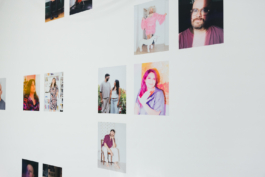
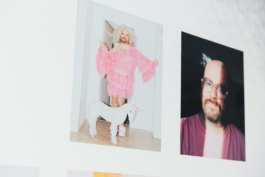
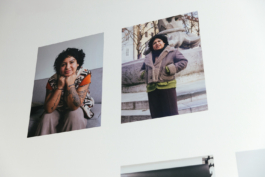
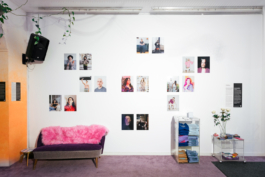
Installation views of Links vor Rechts at Habibi Kiosk, December 2025
II. Links vor Rechts
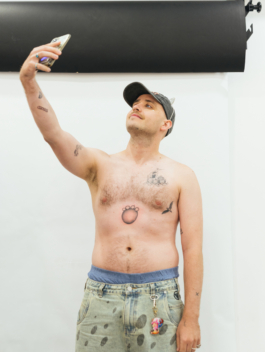
For the sub-project Links vor Rechts (priority to the left), I photographed queer activists in Germany who are standing up against the growing far-right movement and advocating for an open, inclusive, and solidaric society.
The portrait series features nine distinct individuals, ranging from those involved in drag and club culture to those active in digital education and migrant, feminist, or anti-racist initiatives. Together, these portraits highlight the diversity of queer political engagement today. Each person represents those who consciously use their visibility as a political act.
The title deliberately plays with the German traffic rule “priority to the right.” Leftist, feminist, queer, and anti-racist positions are increasingly labeled as “radical,” even though they simply defend human rights. As right-wing forces gain power and democratic spaces shrink, progressive politics once again meets resistance. With its title, the project takes a clear stance: solidarity comes first; diversity has the right of way; the future belongs to those who live openly and stand up for others.
X
X
X
III. Queere Zukünfte
The workshop Queere Zukünfte (Queer Futures), which I developed together with Stella Deborah Traub as an artistic-research format, explores how collective practices can strengthen hope, imagination, and resilience in times of increasing queer hostility. The aim is to create a space in which queer people can collaboratively imagine and shape alternative futures, beyond cis-heteronormative narratives.
The workshop follows a two-part structure: It begins with a theoretical input introducing methods of design futuring, speculative approaches that make societal alternatives visible, followed by a practical, collaborative phase. Participants collectively design and build a sculpture made of wire mesh and modeling clay, conceived as a “figure of resistance” embodying collective strength, vulnerability, and hope.
Methodologically, the workshop draws on established approaches such as the Polak Game, which makes individual orientations toward the future physically tangible, and Hopeful Signals, a collection of small indicators of social change that spark hope. These signals, ranging from political achievements to personal observations, serve as starting points for envisioning Future Scenarios.
The workshop is open to queer people of diverse identities (FLINTA*, trans*, inter*, non-binary, gay, lesbian, bi) and requires no prior experience. What matters most is openness, respect, and a desire for creative exchange. It can be booked by organizations, initiatives, and cultural institutions as a transferable format and adapted to different group contexts and settings.
On 6/12, a full-day workshop developed as part of the project took place within the framework of the exhibition. The workshop Queere Zukünfte, conceived together with artist Stella Deborah Traub, invited participants from the LGBTQIA+ community to engage with questions of queer resilience, speculative future thinking, and collective forms of resistance through artistic and collaborative methods.
Big thanks for the support and collaboration to:
Stella Deborah Traub (Directing and Editing), Nadja Ißler (Camera), Tobias Strobel (Mask and Animation), Johannes Geitl (Costume), Jay Miniano (Make-up tips), Sophie Haydee Colindres Zühlke (Performance), Viola Glink (Stage Presence), Sherwin Douki (Voice) and Sandra Singh (Documentation)
The finissage on 12/12 also marked the performative conclusion of the exhibition. In the form of a drag performance, the installation was deliberately dismantled and transformed into a performative act. This was followed by an artist talk with myself and Paula Lochte, moderated by Sophie Eisenried, in which the creative process, artistic strategies, and conceptual questions were reflected upon. (Photos: Sandra Singh)
This project was commissioned by the program “Verbindungslinien” of the Berufsverband Bildender Künstler.

x

How can queer resilience be upheld and strengthened in times of discrimination, political shift to the right, and growing uncertainty?
Taking as its starting point the life and work of Dutch artist and resistance fighter Willem Arondeus (1894–1943), this artistic-research project explores what queer resistance meant then and what it can mean today. Arondeus, openly homosexual and a courageous member of the Dutch resistance against the Nazi regime, serves as a historical figure of reference for a contemporary reflection on queer identity, threat, and solidarity.
The project combines biographical investigation with artistic research and socio-political analysis. In an era of increasing uncertainty and anti-queer rhetoric, it seeks to highlight the strategies queer people develop today to strengthen resilience, and how empowerment, visibility, and resistance can be rooted within collective experience.
The exhibited works aim to expand queer memory culture, create spaces for dialogue, and open new perspectives.
If you are interested in the link for the film, please send me a message.
"Let it be known that homosexuals are not cowards." — From the legacy of Willem Arondeus, 1943
The first exhibition is a production of the Habibi Kosk of the Münchner Kammerspiele and took place from 29/11 to 12/12/2025. The Habibi Kiosk is an open exhibition and project space and is located in the Maximilianstraße in Munich. As a low-threshold venue at the intersection of art, theatre, and urban society, it deliberately addresses a diverse audience and provides contemporary artistic positions with high visibility beyond traditional exhibition contexts.
The opening took place on 29/11. The evening began with an introduction to the project by curators Sophie Eisenried and Gina Penzkofer. This was followed by a performance by British spoken-word artist Otis Mensah together with the musician Cavid Dhen, whose contribution thematically engaged with queer resilience, memory, and resistance. (Photos: Sandra Singh)


Installation view of Drag Resistance, 2025 (Photo: Sandra Singh)
Installation view of Drag Resistance, 2025
I. Drag Resistance
The sub-project Drag Resistance is a short film and performance-based work conceived as a homage to the Dutch artist and resistance fighter Willem Arondeus (1894–1943). Arondeus was an illustrator, writer, and openly homosexual activist who joined the Dutch resistance during World War II. Together with fellow artists, he forged identity documents and helped lead the 1943 attack on the Amsterdam Public Records Office, an act that destroyed thousands of records and saved countless lives.
The film reinterprets Arondeus’ legacy through drag as an aesthetic and political language. Combining archival references, spoken word, and performative imagery, drag becomes a medium of transformation, disguise, and empowerment, echoing Arondeus’ use of camouflage, false identities, and artistic practice as tools of resistance.
At the center of the film is my drag persona, Aron Divine, whose performance bridges past and present. Through costume, movement, and projection, the film embodies queer resilience and asks how historical acts of resistance can be translated into contemporary forms of visibility and self-assertion. Rather than reconstructing history, the film activates it, using performance to carry memory forward and to affirm drag as a living, defiant practice of remembrance.
The film is part of a video installation and is projected directly onto the costume worn in the performance. In the exhibition context, the costume functions as an autonomous sculptural body and projection surface, allowing the moving image to inhabit the garment itself.
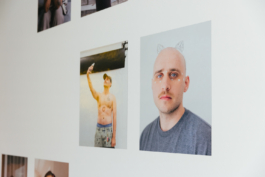


Bonyad Bastanfar and Neda Paiabandi for Links for Rechts, 2025
Bonyad Bastanfar for Links for Rechts, 2025
Neda Paiabandi for Links for Rechts, 2025
Toni Karat for Links for Rechts, 2025
Caspar Weimann for Links for Rechts, 2025
Jules Romeo for Links for Rechts, 2025
Mel for Links for Rechts, 2025
Roxy Rued for Links for Rechts, 2025
Melissa Kolukisagil for Links for Rechts, 2025
Saeleen Bouvar for Links for Rechts, 2025
II. Links vor Rechts
For the sub-project Links vor Rechts (priority to the left), I photographed queer activists in Germany who are standing up against the growing far-right movement and advocating for an open, inclusive, and solidaric society.
The portrait series features nine distinct individuals, ranging from those involved in drag and club culture to those active in digital education and migrant, feminist, or anti-racist initiatives. Together, these portraits highlight the diversity of queer political engagement today. Each person represents those who consciously use their visibility as a political act.
The title deliberately plays with the German traffic rule “priority to the right.” Leftist, feminist, queer, and anti-racist positions are increasingly labeled as “radical,” even though they simply defend human rights. As right-wing forces gain power and democratic spaces shrink, progressive politics once again meets resistance. With its title, the project takes a clear stance: solidarity comes first; diversity has the right of way; the future belongs to those who live openly and stand up for others.


Installation views of Links vor Rechts at Habibi Kiosk, December 2025
III. Queere Zukünfte
The workshop Queere Zukünfte (Queer Futures), which I developed together with Stella Deborah Traub as an artistic-research format, explores how collective practices can strengthen hope, imagination, and resilience in times of increasing queer hostility. The aim is to create a space in which queer people can collaboratively imagine and shape alternative futures, beyond cis-heteronormative narratives.
The workshop follows a two-part structure: It begins with a theoretical input introducing methods of design futuring, speculative approaches that make societal alternatives visible, followed by a practical, collaborative phase. Participants collectively design and build a sculpture made of wire mesh and modeling clay, conceived as a “figure of resistance” embodying collective strength, vulnerability, and hope.
Methodologically, the workshop draws on established approaches such as the Polak Game, which makes individual orientations toward the future physically tangible, and Hopeful Signals, a collection of small indicators of social change that spark hope. These signals, ranging from political achievements to personal observations, serve as starting points for envisioning Future Scenarios.
The workshop is open to queer people of diverse identities (FLINTA*, trans*, inter*, non-binary, gay, lesbian, bi) and requires no prior experience. What matters most is openness, respect, and a desire for creative exchange. It can be booked by organizations, initiatives, and cultural institutions as a transferable format and adapted to different group contexts and settings.
On 6/12, a full-day workshop developed as part of the project took place within the framework of the exhibition. The workshop Queere Zukünfte, conceived together with artist Stella Deborah Traub, invited participants from the LGBTQIA+ community to engage with questions of queer resilience, speculative future thinking, and collective forms of resistance through artistic and collaborative methods.
The finissage on 12/12 also marked the performative conclusion of the exhibition. In the form of a drag performance, the installation was deliberately dismantled and transformed into a performative act. This was followed by an artist talk with myself and Paula Lochte, moderated by Sophie Eisenried, in which the creative process, artistic strategies, and conceptual questions were reflected upon. (Photos: Sandra Singh)
Big thanks for the support and collaboration to:
Stella Deborah Traub (Directing and Editing), Nadja Ißler (Camera), Tobias Strobel (Mask and Animation), Johannes Geitl (Costume), Jay Miniano (Make-up tips), Sophie Haydee Colindres Zühlke (Performance), Viola Glink (Stage Presence), Sherwin Douki (Voice) and Sandra Singh (Documentation)
This project was commissioned by the program “Verbindungslinien” of the Berufsverband Bildender Künstler.

© Francesco Giordano, 2026 Impressum + DSVGO